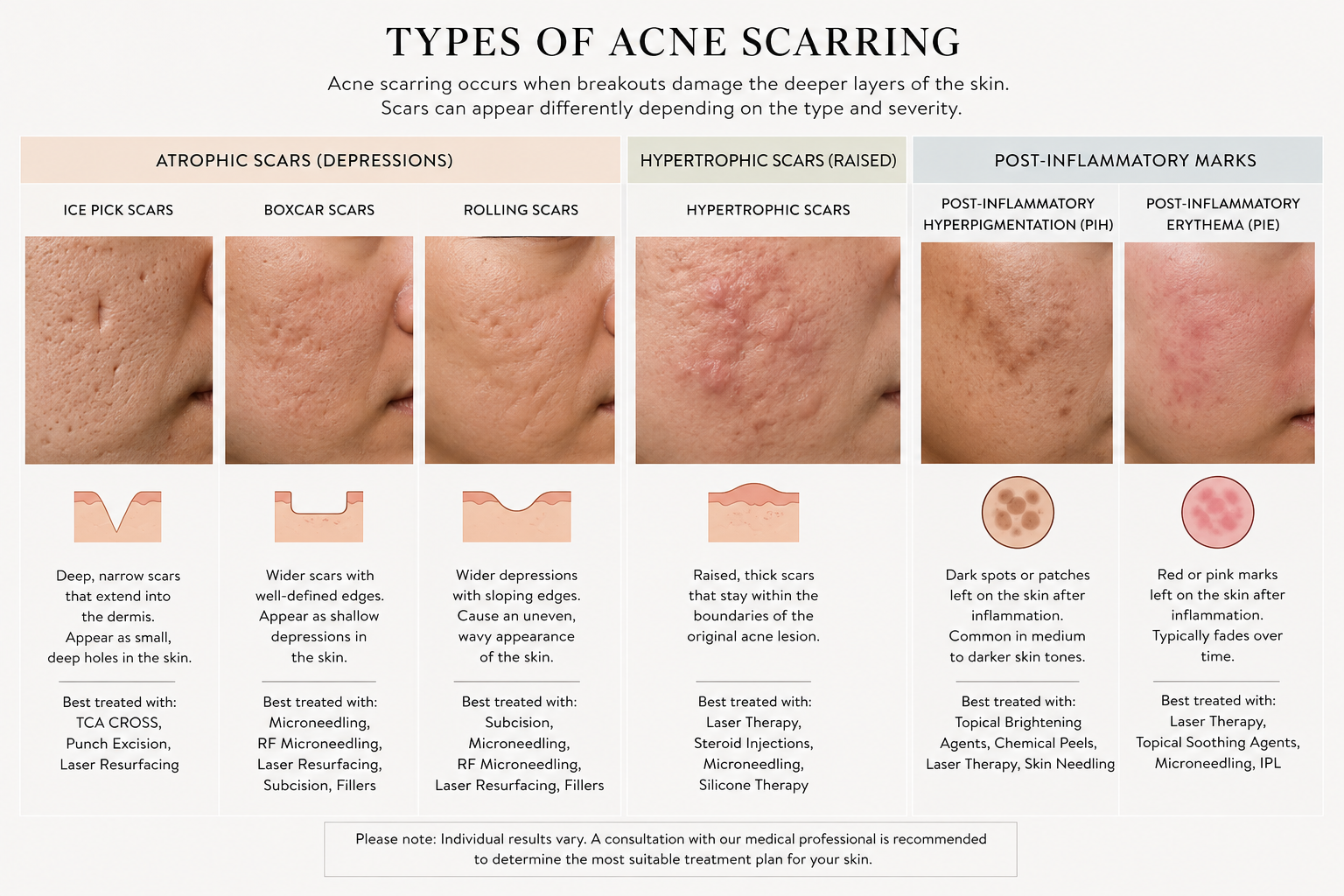
The main types of scarring from acne are depressed scars and raised scars. Depressed, or atrophic, scars include ice pick, boxcar and rolling patterns. Raised scars include hypertrophic, keloid and less common papular scars. Flat red or brown marks may follow acne too, but they are usually colour changes rather than structural scars.
What are the main types of scarring from acne?
Acne scarring is usually classified as depressed or raised. Depressed scars form when healing leaves insufficient structural support beneath the skin. This group includes ice pick, boxcar and rolling scars. Raised scars develop when healing creates elevated scar tissue. Flat post-acne marks generally affect colour rather than skin depth.
An acne scar is a structural change that remains after an inflammatory acne lesion has healed. The surface may sit below the surrounding skin, rise above it or show a combination of patterns.
Different types of acne scarring can occur within the same cheek, jawline or body area. For example, a person may have narrow ice pick scars beside wider boxcar depressions, together with brown or red marks.
The scar name describes its visible shape. It does not establish severity or determine treatment by itself. Depth, tethering and the skin’s healing response also influence the clinical significance of each area. The American Academy of Dermatology similarly separates acne-related changes into depressed scars, raised scars and flat post-inflammatory spots that are usually not true scars.
|
Category |
Main patterns |
Surface clue |
Structural scar? |
|---|---|---|---|
|
Depressed scars |
Ice pick, boxcar, rolling |
Indentation or uneven texture |
Yes |
|
Raised scars |
Hypertrophic, keloid, papular |
Firm or elevated area |
Yes |
|
Post-acne marks |
Brown, grey, red or pink |
Flat colour change |
Usually no |

Why does acne leave different scar patterns?
Different patterns form because injured skin does not always replace damaged tissue in the same way. Too little supporting collagen can leave an indentation. Excess or unusually organised scar tissue can create a raised area. Inflammation may also alter pigment or visible blood vessels without changing the surface structure.
Inflammatory acne can damage collagen and other supporting structures within the dermis. Deeper nodules and cysts generally carry a greater scarring risk than superficial comedones. Picking, squeezing or scratching an inflamed lesion can add further injury and increase that risk.
Collagen loss can leave depressed scars
Skin normally produces new collagen while repairing an injury. When the repair process does not replace enough of the lost support, the healed surface may settle below the surrounding skin.
The shape of that depression depends on how widely and deeply the tissue was affected. A narrow column of damage may produce an ice pick pattern. Broader tissue loss can leave boxcar or rolling scars.
Excess scar tissue can create raised scars
Raised scars form when the repair response produces more scar tissue than the area requires. Hypertrophic scars usually stay within the approximate boundary of the original inflammation. Keloids can extend beyond it.
Not every firm bump after acne is a keloid. Persistent acne, cysts and several non-acne skin conditions can produce a similar appearance, so a changing raised area should be assessed before treatment is considered.
Inflammation can leave colour without changing texture
Inflammation can stimulate excess pigment or leave persistent visible redness after a lesion has flattened. The surface may feel smooth even though the area remains brown, grey, pink or red. These flat changes differ from structural scars, although both concerns can occur together.
Atrophic acne scars include ice pick, boxcar and rolling scars
Atrophic acne scars appear as depressed areas beneath the skin surface. Ice pick scars are small and deep, while boxcar scars are wider with clearly defined edges. Rolling scars tend to be wider, shallower and softer at their borders. These types of acne scars often appear together rather than as isolated patterns.
An in-person assessment provides a clearer view of scar depth and whether tethering contributes to the depression. A narrow scar extending deeply into the skin cannot be assessed in the same way as a shallow, tethered depression covering a wider area. A front-facing photograph may show surface shadows but not the full depth or attachment beneath the skin.
Ice pick scars are narrow and extend deeply
An ice pick scar has a small opening at the surface and a narrow tract extending into deeper tissue. Its steep sides can create a puncture-like appearance.
Some ice pick scars initially resemble enlarged pores. The distinction is not always clear in photographs because direct lighting can hide depth. A scar may also have an irregular opening or extend farther beneath the surface than expected.
Not every small pit is an ice pick scar. Enlarged follicles, shallow boxcar scars and other textural changes may create similar shadows. Clinical assessment considers the opening, border, depth and relationship to previous inflammatory acne.
The narrow structure also explains why a treatment aimed broadly at surface texture may not address every deep focal scar in the same way.
Boxcar scars are broad depressions with distinct borders
A boxcar scar is a round or oval depression with comparatively clear borders. Some are shallow, while others extend more deeply into the dermis.
Directional lighting may create a sharper shadow along the edge than it would around a rolling scar. The base may appear relatively flat, although the width and depth can vary across the same area.
Boxcar scars can resemble scars left by chickenpox or other injuries. Larger pores can also create confusion when viewed close up. Previous acne history and the three-dimensional structure help distinguish these concerns.
Rolling scars create wide, undulating depressions in the skin
Rolling scars usually have broad depressions with soft or sloping edges. Several scars can overlap visually, giving the skin an undulating or wave-like surface.
Fibrous bands beneath the skin may pull the surface down and contribute to this pattern. This attachment is often described as tethering. It may become more visible under gentle side lighting or when facial movement changes the shadows across the area.
Rolling texture can also be confused with general unevenness or skin laxity. An in-person assessment provides a clearer view of scar depth and whether tethering contributes to the depression.
|
Feature |
Ice pick |
Boxcar |
Rolling |
|---|---|---|---|
|
Surface opening |
Small |
Medium to broad |
Broad |
|
Typical depth |
Deep |
Variable |
Often shallower |
|
Overall appearance |
Puncture-like pit |
Round or oval depression |
Wavy texture |
|
Common lookalike |
Enlarged pore |
Chickenpox-type scar |
General unevenness |
A person may have all three patterns within a small area. Classification provides a useful starting point, while an in-person assessment gives a clearer understanding of scar depth, tethering and treatment suitability.
Raised acne scars include hypertrophic, keloid and papular scars
Raised acne scars sit above the surrounding skin and differ structurally from atrophic scars. Hypertrophic scars are firm and remain within the original area of injury. Keloids may grow beyond that boundary. Papular scars are less common raised-appearing bumps that can sometimes be mistaken for active acne.
Raised scars may develop around the jawline, chest, shoulders or upper back. These areas can be more prone to persistent raised scarring after inflammatory acne. Ongoing growth, itching, tenderness or a changing appearance warrants professional assessment.
Hypertrophic scars remain firm and raised
A hypertrophic acne scar is an elevated area of scar tissue that generally stays within the boundary of the original lesion. It may feel firmer than the surrounding skin and can appear pink, red, brown or close to the person’s natural skin tone.
The surface may gradually settle, but the course differs between individuals. A firm raised area should not be scrubbed, squeezed or treated with home needling.
Keloids may spread past the site of the initial breakout
A keloid grows beyond the approximate border of the acne lesion that triggered it. It may continue to become thicker or wider after the original inflammation has resolved.
Keloids require a cautious medical assessment because they behave differently from depressed scars. Procedures intended to resurface atrophic scars are not automatically appropriate for growing or symptomatic raised tissue.
Papular scars can resemble persistent acne bumps
Papular acne scars appear as small, firm, skin-coloured or pale bumps. Published clinical reports describe them as an under-recognised scar pattern that may be mistaken for acne that has not cleared.
Papular scars may differ biologically from hypertrophic scars and keloids. A clinical assessment can help distinguish papular scarring from persistent acne or another skin concern. Persistent bumps around the nose, chin, jawline or trunk should be examined before treatment.
Are red or brown acne marks actually scars?
A flat red, pink, brown or grey mark after acne is usually a post-inflammatory colour change rather than a structural scar. True acne scars alter texture by creating an indentation or raised area. Colour changes may gradually become less visible, while structural scars are more likely to persist.
A useful preliminary distinction is whether the surface remains flat. A flat area that differs only in colour is more consistent with post-inflammatory pigmentation or redness. A dip, raised area or lasting change in the skin’s surface may suggest structural scarring.
The separation between the two is not always precise. Some areas contain both discolouration and an atrophic or raised scar.
Post-inflammatory hyperpigmentation changes colour, not depth
Post-inflammatory hyperpigmentation develops when inflammation stimulates increased pigment production. The resulting area may appear brown, dark brown, grey or darker than the surrounding skin.
The mark remains flat because tissue depth has not necessarily changed. It should not automatically be described as a pigmentation scar.
Persistent redness can remain after inflammation
Pink or red areas can remain after an inflamed lesion settles. This is often described as post-inflammatory erythema and may reflect lingering vascular and inflammatory change rather than collagen loss.
Redness can appear more obvious under bright light, after exercise or when the skin becomes warm. Its presence does not establish that an indentation is also present.
Some areas have both discolouration and textural scarring
A brown mark can sit over a boxcar scar. Redness may also surround rolling texture or a raised lesion. This overlap is why different types of acne scarring cannot always be classified by colour alone.
W Medical Aesthetics assesses acne scarring and post-inflammatory pigmentation as related but distinct concerns. The clinic’s skin-concern guidance similarly separates flat pigmentation from atrophic and raised scars.
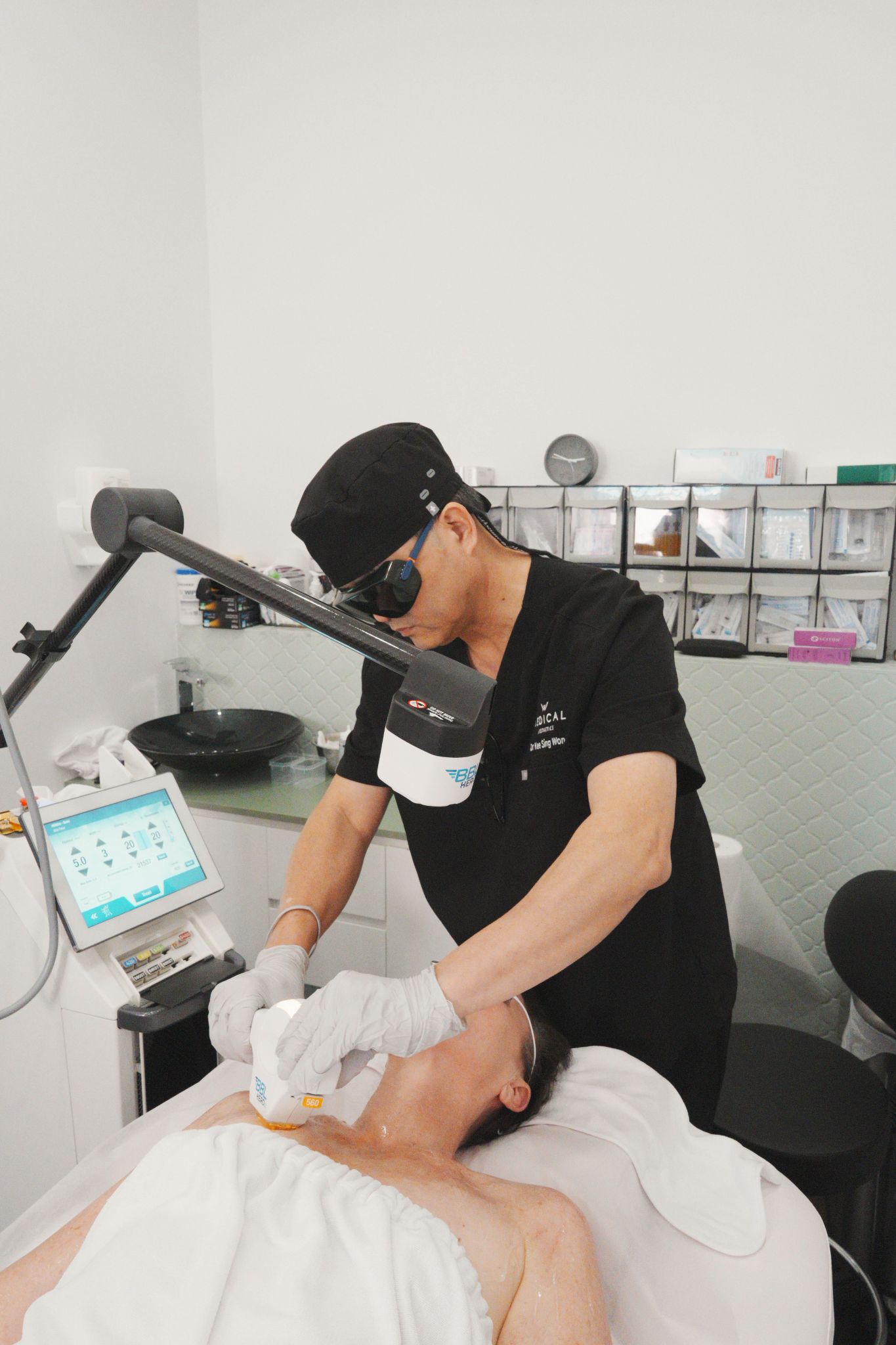
Where clinically appropriate, BBL HEROic or MOXI may be considered for concerns such as post-acne pigmentation, persistent redness or uneven tone. These treatments do not address every type of acne scar, and their suitability, expected outcome and required number of sessions vary between individuals. Deeper or pitted scars require a separate assessment of their structure.
How can you recognise different acne scar types at home?
You can make a preliminary comparison by looking at clean skin under soft side lighting. This may help show whether the concern is flat, indented or raised, although an assessment is still needed to understand its depth. Border shape, apparent depth and the way shadows change can provide useful clues. However, home observation cannot reliably confirm depth, tethering or treatment suitability.
Use the following steps as an observation guide rather than a diagnostic test:
- Remove makeup and heavy skincare: Examine the natural skin surface without products filling shallow depressions.
- Compare front and side lighting: Use soft daylight rather than a direct flash.
- Check the surface level: Note whether the area is flat, depressed or raised.
- Observe the border shape: Look for narrow, defined or gradually sloping edges.
- Compare nearby patterns: Several scar types may appear within one area.
- Check for active inflammation: Note new breakouts, tenderness, itching or continued growth.
- Avoid manipulating the area: Stretching, squeezing and repeated touching can distort its appearance.
Side lighting can reveal texture more clearly
Direct front lighting can flatten shadows and make depressions seem less visible. A camera flash may do the opposite by creating sharp shadows that exaggerate shallow irregularities.
Soft light arriving from the side can show how the surface changes across the cheek or jawline. Comparing several lighting angles is more useful than relying on one close-up image.
A photograph cannot show every treatment-relevant feature
A photograph cannot reliably show how far a scar extends beneath the surface. It also cannot confirm whether fibrous bands are tethering the skin.
Other relevant features include active acne, sensitivity, pigmentation tendency, healing history and previous procedures. These factors may change the immediate priority even when the visible scar pattern seems clear.
An online guide can support recognition, but it cannot diagnose scar depth or confirm whether a procedure is appropriate.
Why does acne scar type change the treatment plan?
Acne scar treatments address different structural problems. Resurfacing may support selected textural scars, while deep focal pits, tethered depressions, raised tissue and flat colour changes can require different principles. Active acne, skin characteristics, pigmentation risk and recovery preferences also influence what may be suitable.
No single procedure should be assumed to treat every scar pattern. A device that supports surface remodelling may not release deeper tethering. A treatment intended for pigmentation will not rebuild a deep indentation. Raised scars require a different approach from depressed scars.
|
Concern identified |
Clinical objective |
|---|---|
|
Narrow, deep depressions |
Address individual deep scars |
|
Broad, defined depressions |
Improve edges, depth and nearby texture |
|
Rolling or tethered scars |
Address underlying restriction |
|
Raised scars |
Reduce and control raised tissue |
|
Flat brown or red marks |
Address colour rather than depth |
|
Mixed scarring |
Combine or stage suitable approaches |
Textural scars and colour changes need different strategies
A treatment plan begins by deciding whether the main concern is texture, colour or both. This prevents a flat brown mark from being managed as though it were a deep scar.
At W Medical Aesthetics, Tetra Pro CO2 Laser resurfacing may be considered for selected atrophic acne scars and textural concerns. The treatment delivers fractional CO2 energy to create controlled treatment zones within the skin. Its suitability, treatment intensity, expected recovery, number of sessions and potential degree of improvement depend on an individual clinical assessment. It is not appropriate for every scar pattern or skin type.
Colour-focused treatment may form a separate stage where redness or pigmentation remains. The sequence depends on the condition of the skin rather than a universal device order.
Mixed scars may need a staged approach
Different parts of the same cheek may not receive identical treatment. A narrow ice pick scar, a tethered rolling depression and a flat pigment mark represent different targets.
A staged plan allows each concern to be assessed separately. It may also provide time to observe healing and pigment response before progressing to another treatment principle.
Morpheus8 RF microneedling may be considered as part of a treatment plan for selected acne-scar and textural concerns. It is not suitable for every type or depth of acne scar. Suitability for this treatment is determined through an individual clinical assessment of the scar structure, skin characteristics, pigmentation risk, previous healing response and recovery preferences.
Active acne changes the immediate priority
New inflammatory lesions can create further pigmentation and scarring. Managing active acne may therefore take priority before intensive scar procedures begin.
Early acne care and avoiding picking can help reduce additional tissue injury. A consultation may conclude that scar treatment should be delayed while inflammation is brought under better control.
Results from procedural acne-scar treatment are gradual and vary between individuals. No specific degree of improvement can be guaranteed. Depending on the scar pattern, depth, skin characteristics and healing response, more than one session or a staged combination of treatment approaches may be required. Some scars may remain visible after treatment.
When should acne scarring be professionally assessed in Adelaide?
Professional assessment is useful when scarring is mixed, deep, raised, changing or difficult to distinguish from pigmentation. It is also appropriate when active acne continues to produce new marks or when previous treatments have caused prolonged redness, pigmentation or unexpected healing.
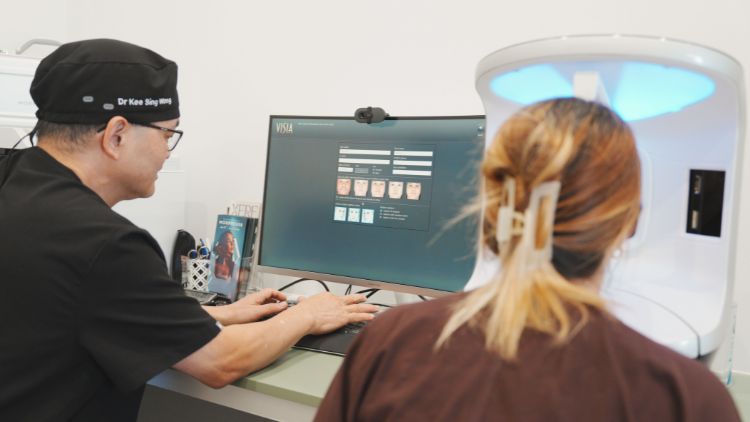
At W Medical Aesthetics in Adelaide, acne scarring is assessed through an individual clinical consultation. The assessment considers the visible scar pattern together with factors that cannot be confirmed from a photograph, including scar depth, tethering, pigmentation risk, active acne and previous healing responses.
A consultation does not automatically lead to a procedure. Assessment may indicate that active acne should be managed first. A raised area may need further investigation, or the expected benefit may not justify the proposed recovery.
What is assessed during the consultation
A clinical acne-scarring assessment can consider:
- Whether the concern involves texture, colour or both
- Scar depth, width and border shape
- Possible tethering beneath depressed scars
- Raised, symptomatic or changing tissue
- Ongoing breakouts at the treatment site
- Baseline skin colour and pigment stability
- Earlier scar treatments and their outcomes
- Expected improvement and recovery preferences
Treatment planning also considers the amount of downtime a person is comfortable with and whether the proposed outcome is realistic. Selecting a procedure from social-media photographs cannot provide the same information.
An assessment does not guarantee that a procedure will be recommended or performed. The consultation may indicate that active acne should be managed first, that the area should be monitored or that another form of care should be considered before procedural treatment.
Understanding the scar pattern is the first step
Ice pick, boxcar, rolling and raised scars have different structures. Flat red, brown or grey marks are more often post-inflammatory colour changes, although texture and discolouration can appear together.
Correctly identifying the types of scarring from acne provides a more reliable basis for treatment planning than choosing a procedure from a photograph or social-media example. A clinical assessment can also identify active acne, pigmentation risk and features beneath the surface that are not visible online.
Book a consultation at W Medical Aesthetics in Adelaide for an individual acne-scarring assessment. The consultation will consider whether treatment is clinically appropriate, what degree of improvement may be realistic and whether active acne or another concern should be addressed first.
Acne scar types: Frequently asked questions
Will acne scars disappear without treatment?
Flat post-acne colour changes may fade gradually, but true depressed or raised acne scars are less likely to disappear completely without treatment. Their visibility can vary as the skin changes. Suitable professional procedures may soften their depth, edges, colour or overall visibility, although results differ between individuals.
Can skincare remove ice pick, boxcar or rolling scars?
Skincare can support skin health and may improve accompanying pigmentation, dryness or surface roughness. However, topical products cannot physically release tethered tissue or fully rebuild a deep indentation. Structural ice pick, boxcar and rolling scars usually require professional assessment before a procedural option is discussed.
What is the difference between acne scars and enlarged pores?
Enlarged pores are openings around hair follicles, while acne scars result from tissue change after inflammation. Ice pick scars can resemble large pores because both appear as small openings. A scar is more likely to have unusual depth, irregular borders or a pattern associated with previous inflammatory acne.
Can one person have several types of acne scars?
Yes. One area can contain ice pick, boxcar and rolling scars, sometimes together with pigmentation, redness or raised tissue. Mixed patterns are clinically important because separate structures may require different treatment principles rather than one procedure applied uniformly across the area.
Can darker skin tones be treated for acne scarring?
People with different skin tones may be considered for acne-scar treatment, but not every procedure or treatment setting is appropriate for every person. Assessment should consider the scar structure, baseline pigmentation, risk of post-inflammatory pigment change and previous healing responses before an option is discussed. The recommended approach may differ even when two people have a similar visible scar pattern.
Can acne scars be eliminated entirely?
Acne-scar treatment may reduce the visibility of selected scars by softening their apparent depth, edges or surrounding texture. It cannot guarantee complete removal. The degree and duration of improvement vary according to the scar pattern, depth, treatment approach, number of sessions and individual healing response.